英文読解から入試まで 完全マンツーマン指導


https://dictionary.cambridge.org/ja/dictionary/english/
塾長のコラム 2026年7月25日
 |
 |
|
Reporting Verbs 4 |
||
2026年7月25日 皆様、KVC Tokyo 英語塾 塾長 藤野 健です。 語法についてのコラムを長期間続けて来ましたが、今回からは再び文法の解説に戻り、過去のコラムにて纏まったテーマとしては扱って来なかった内容について触れていきます。まぁ、文法の落ち穂拾いとなりますが、これは扱うテーマが<落ち穂>である事とは無関係でであり大切な内容に違いはありませんのでご注意の程を。 さて、英語には直接話法と間接話法の区別があり、これは日本語での 「...」 を使う表現の有無に相当するものになります。日本語では、<彼は私に「君は早く宿題を仕上げてくれ」と言った。>は直接話法ですが、間接話法に換えると、<彼は私に私が早く宿題を仕上げる様に言った。>となります。英語も基本的には同様の考え方での変換が行われるのですが、英語の場合は更に 「...」 内の時制を主節の動詞の時制に応じて変化させる必要が生じます。また、この作法にも幾つかの例外事例や語の用法が存在し、初学者を戸惑わせる場合も見られます。これを鑑み、注意点についてざっと一通り解説して行きましょう。これまでに採りあげてきた文法内容に比較すると理解は容易かと考えます。しかし、この理解は欠かすことの出来ないものですので知識の再確認がてら頭に叩き込んで下さい。 英語には伝聞内容や人の考えた内容を述べる為の一群の動詞が存在し、Reporting Verbs 伝達動詞、報告動詞などと呼称されます。直接話法と間接話法は、それらの動詞が取り得る表現方法の1つの違いに相当するものになります。Reporting Vebrs に関して用例を含めて詳述して行きます。その第4回目です。 *塾長からの批判的検討を加えた上で以下のサイトの内容を参考に執筆しています。https://dictionary.cambridge.org/grammar/british-grammar/reported-speech-direct-speechhttps://www.eapfoundation.com/writing/references/reporting/https://www.ncl.ac.uk/academic-skills-kit/writing/academic-writing/reporting-verbs/https://latrobe.libguides.com/writing/reporting-verbshttps://www.efjapan.co.jp/eigo-resources/english-grammar/reporting-verbs/https://www.twinkl.jp/blog/reporting-verbshttps://centros.edu.xunta.gal/iesfontexeria/aulavirtual/pluginfile.php/36400/mod_resource/content/1/Reporting%20Verbs%20Table.pdfhttps://www.frontiersin.org/journals/psychology/articles/10.3389/fpsyg.2026.1799996/fullPsychol., 02 April 2026 Volume 17 - 2026 | https://doi.org/10.3389/fpsyg.2026.1799996Reporting verbs across genre sets and research paradigms: a corpus-based analysis of denotation and evaluation in applied linguistics research articlesLiming Deng & Xinyue Lihttps://scholarsarchive.byu.edu/facpub/6373/Reporting verb variation across disciplines: An academic corpus studyGrant Eckstein, et al. ournal of Academic Language & Learning Vol. 16, No. 1, 2022, 59-75. ISSN 1835-5196https://journals.rcsi.science/2520-2073/article/view/404684?utm_source=openaiKalpana Ranganathan and Abdu Al-Kadi, (Re)voicing in academic writing: A study of reporting verbs in writing theses in hard sciencesTraining, Language and Culture _73, 2025 |
||
 |
 |
https://www.youtube.com/watch?v=9VpmiyB0nEU
Verb+object +Preposition English with Kaleem 2021/03/25
<動詞+人+前置詞+名詞/動名詞>の組み合わせのスタイルに於いて、
目的語である「人」が以下の動詞或いは名詞の主語として理解可能な例
は限られたものであることが理解出来ます。
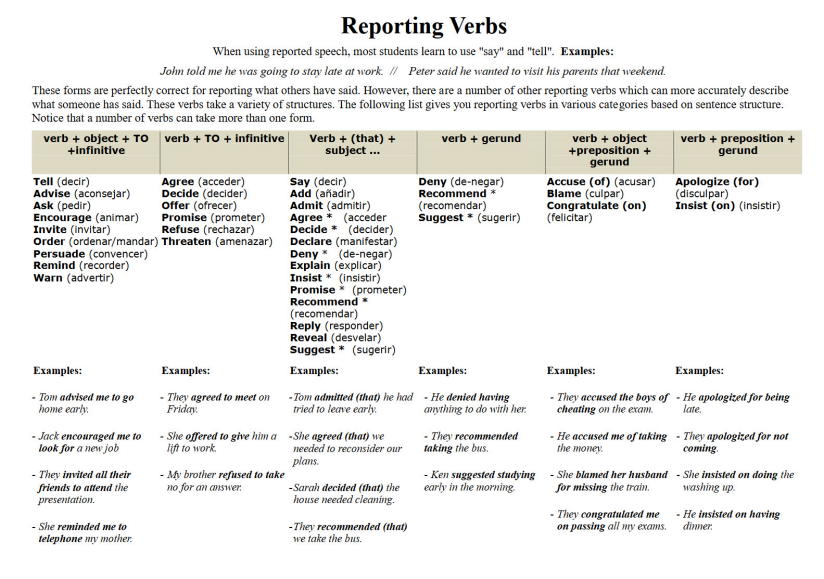
https://centros.edu.xunta.gal/iesfontexeria/aulavirtual/pluginfile.php
/36400/mod_resource/content/1/Reporting%20Verbs%20Table.pdf
このサイトからお借りした一覧表です。縮小されていて見にくいですので
是非実際に訪問して確認してください。役に立ちます。
|
|
|
Reporting Verbs の文法 3*間接話法に於いて、Reporting Verbs の後ろには、しばしば that 節、if/whether 節、或いは 疑問詞で始まる節が続きます。*これらのものの多くは直接話法に置き換えることも可能です。その直接話法の表現が一般的に利用されるものであるかどうかは別として。*しかし、すべての Reporting Verbs がこの様なパターンに従うわけではありません。*個々の動詞について取り得る文型や動詞型を必ず辞書にて確認し、用法を正しく覚えることが大切です。*reporting verbs の原義から、いずれに於いても主節動詞以下は S+V の意味構造、<伝えたいことの中身>を持つことになります。1.Reporting Verbs (間接話法形式)の構文/動詞型に拠る分類 (つづき)6.主語 + 動詞 + 人 + 前置詞+動名詞/名詞 <Subject + Reporting Verb + Person + Preposition + Gerund/Non>*<人 + 前置詞+動名詞/名詞> の部分が <S+V> の意味になります。*このパターンを取る動詞自体は数多いですが、後ろの部分を<S+V> の意味として解釈可能なものは多くはありません。*利用される前置詞は for, of, on, about, against, about などに限定されます。*この種の動詞を、Reporting Verbs として眺めることは、動詞型の理解に新たな視点を与えるでしょう。*まぁ、前から後ろへと読み下す速読・速解のキモにもなりますね。accuse someone ofShe accused him of breaking his promise.彼女は彼が約束を破ったと非難した。= She accused <he broke his promise>.blame someone forThey blamed me for ruining the evening.彼らは私がその晩を台無しにしたと責めた。= They blamed <I ruined the evening>.commend someone forThe teacher commended her for showing great patience.先生は彼女が大きな忍耐を示したことを褒めた。= The teacher commended <she showed great patience>.congratulate someone onWe congratulated him on winning the prize.私たちは彼がその賞を取ったことを祝った。= We congratulated <he won the prize>.criticize someone forThe editor criticized the writer for repeating the same image.編集者は作家が同じイメージを繰り返したことを批判した。= The editor criticized <the writer repeated the same image>.praise someone forThey praised her for speaking with such calm dignity.彼らは彼女がとても落ち着いた品位ある話し方をしたことを褒めた。= They praised <she spoke with such calm dignity>.reassure someone aboutHer friend reassured her about not falling behind.友人は、遅れを取っているわけではないと彼女を安心させた。= Her friend reassured <she was not falling behind>.reprimand someone forThe manager reprimanded him for ignoring the rules.部長は彼が規則を無視したことで叱責した。= The manager reprimanded <he ignored the rules>.scold someone forShe scolded the child for telling a lie.彼女はその子がうそをついたことで叱った。= She scolded <the child told a lie>.thank someone forI thanked her for helping me in silence.私は彼女が黙って助けてくれたことに感謝した。= I thanked <she helped me in silence>.warn someone againstHe warned me against trusting the stranger too easily.彼はその見知らぬ人を簡単に信用しないよう私に警告した。= He warned <I trusted the stranger too easily>.warn someone ofWHO has warned governments of the serious consequences of climate change.WHOは各国政府に対して、気候変動がもたらす深刻な影響について警告してきた。= WHO has warned <governments can suffer the serious consequences of climate change>.*動詞ごとに後ろの前置詞がほぼ決まっています。of を取るものaccuse 人 of doing, warn 人 of doingfor を取るものblame, commend, criticize, praise, reprimand, scold, thank (人 for doing)on を取るものcongratulate 人 on doingagainst を取るものwarn 人 against doingabout を取るものreassure someone about |
||
|
|